
How much protein can your body absorb at one time: The Truth About 20–30 g

Updated: Aug 12
If you've ever been told that your body can only absorb 20–30 g of protein at one meal, you've probably heard a useful concept presented as a biological rule. It isn't.
Your digestive system does not suddenly stop absorbing protein after 20, 25 or 30 g. Protein is digested into amino acids and peptides, absorbed from the gastrointestinal tract and made available to tissues throughout the body.
The more interesting question is different:
If your body absorbs the protein, does eating more protein at one time keep increasing muscle protein synthesis (MPS) indefinitely?
The answer is also no. But for a completely different reason. Protein absorption and muscle protein synthesis are not the same process.
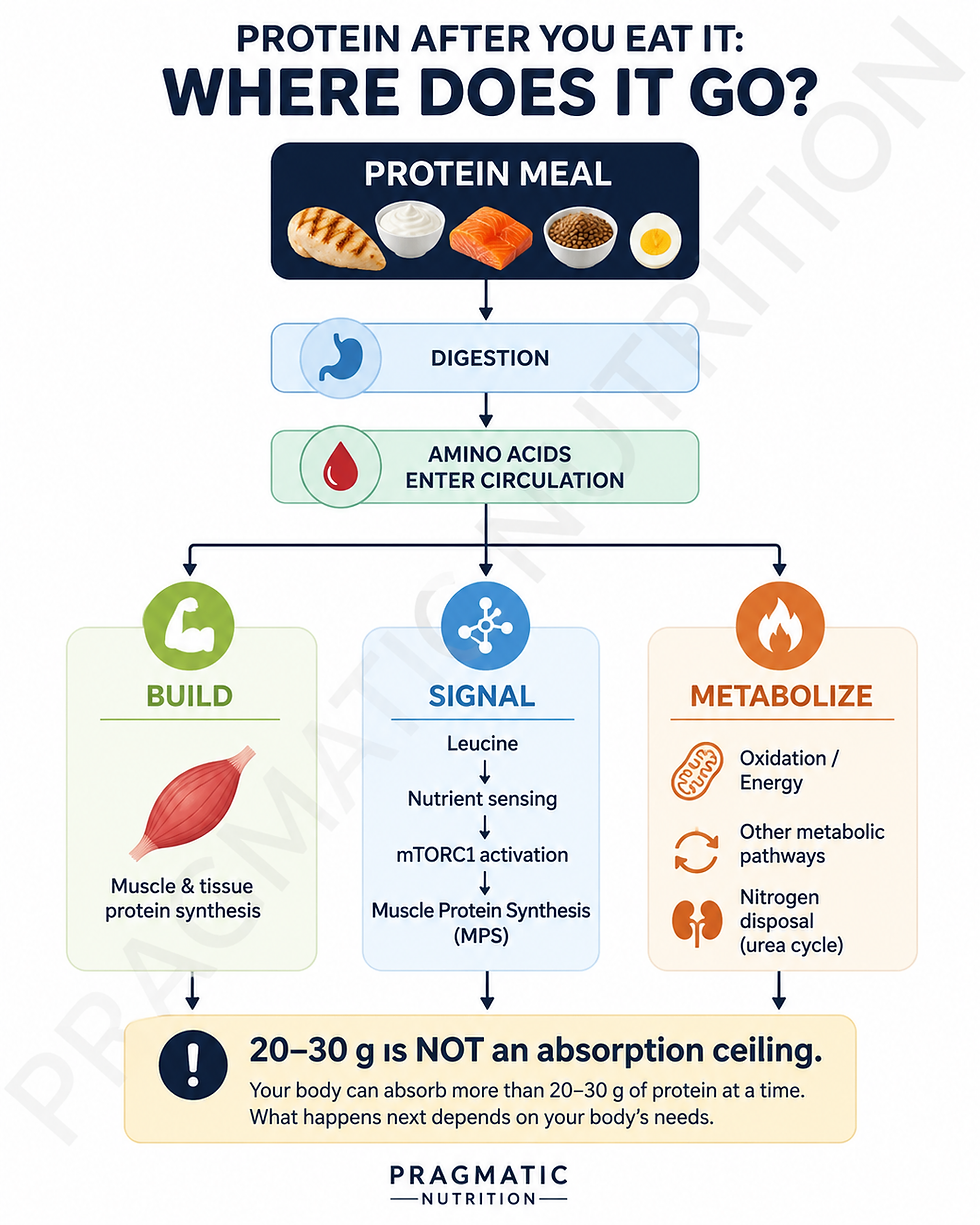
And understanding that distinction helps explain the so-called “muscle-full” effect, the role of leucine and mTORC1, why amino-acid oxidation can increase after larger protein doses, and why the frequently quoted 20–25 g number should never be treated as a universal protein ceiling.
How Much Protein Can Your Body Absorb At One Time?
Let's separate three questions that are often mixed:
Question | What the evidence suggests |
Can the body absorb more than 20–30 g protein from a meal? | Yes |
Does MPS keep increasing proportionally with every additional gram? | No |
Are amino acids beyond the dose producing maximal MPS simply “wasted”? | No |
The body doesn't throw away protein simply because a meal contains more than 20–30 g.
Amino acids can contribute to:
muscle and other tissue protein synthesis
whole-body protein turnover
synthesis of enzymes, hormones and other compounds
oxidation for energy
other metabolic pathways
The fate of amino acids depends on the amount consumed, protein quality, energy availability, exercise stimulus, timing and the body's current metabolic demands.
So when someone says: “You can only absorb 25 g of protein at once,” they are confusing absorption with the dose-response of MPS.
What is the “muscle-full” effect?
The idea of the muscle-full effect comes from research showing that after a protein or amino-acid dose, MPS rises for a period and then returns toward baseline even though amino acids may remain elevated in the blood.
One early human study found that MPS increased after amino-acid infusion and then returned toward baseline despite continued elevation of plasma amino acids. A later study demonstrated a similar time-dependent response after oral protein ingestion. (PubMed). This is an important finding.
But it does not mean: “Your muscles can only use 20 g of protein.”
It means that the stimulation of MPS is regulated and transient. After a sufficiently stimulating protein dose, the muscle enters a period in which another immediate increase in MPS is limited. This is better understood as a temporary refractory period and diminishing-return response, rather than a hard protein ceiling.
Recent reviews continue to describe this transient response and refractory period, while emphasizing that the response depends on factors such as protein dose, exercise, age and physiological state. (PubMed)
So where did the 20–25 g number come from?
This is where nutrition advice often becomes oversimplified. A frequently cited study examined different doses of whey protein in young resistance-trained men and found that 20 g was sufficient to stimulate MPS under those particular experimental conditions. However, the 40-g dose increased amino-acid oxidation and urea production. (PubMed)
That finding became widely translated into: “20 g is all your muscles can use.”
That's not what the study showed. It showed a particular dose-response under a particular experimental setup. And other research demonstrates why we should be cautious about turning that number into a universal rule.
Does 40 g of protein stimulate more MPS than 20 g?
Sometimes, yes. A particularly useful study compared 20 g versus 40 g of whey protein after whole-body resistance exercise in resistance-trained young men. The researchers found that MPS was significantly greater after 40 g than after 20 g. (PubMed)
This is an important challenge to the simplistic “20 g ceiling.” It tells us that the optimal dose cannot be reduced to one universal number.
The MPS response can depend on:
body size
lean mass
amount of muscle activated during exercise
type and amount of exercise
protein quality
age
sex
total daily protein intake
meal composition
time since the previous meal
A review of the muscle-protein response after resistance exercise similarly concluded that recommendations need to be individualised according to the protein source, meal composition, timing and characteristics of the athlete. (PubMed)
The better way to say it
20–30 g may be a useful practical target for many meals, but it is not a biological absorption limit or a universal MPS ceiling.
That's an important distinction.
What does leucine actually do?
This is where the biology gets particularly interesting. Leucine is an essential amino acid and one of the most important amino acids involved in regulating the muscle's response to protein. But leucine has two different identities:
1. Leucine is a building block
It can be incorporated into newly synthesized proteins.
2. Leucine is also a nutrient signal
Leucine participates in signalling pathways that tell the cell that amino acids are available. One of the best-characterized mechanisms involves Sestrin2 and mTORC1.
Research has demonstrated that leucine binds to Sestrin2 and influences the Sestrin2–GATOR2 system, thereby regulating mTORC1 signalling. (PubMed). mTORC1 then regulates downstream processes involved in translation and protein synthesis.
A simplified pathway looks like this:
Protein eaten
↓
Digestion
↓
Amino acids enter circulation
↓
Leucine availability increases
↓
Leucine sensing / mTORC1 signalling
↓
Protein synthesis machinery activated
↓
MPS increases
This is why leucine is important. But there is a crucial point:
Leucine does not need to be broken down first to perform its signalling role.
Its signalling function and its later metabolic fate are separate concepts.
Does leucine being ketogenic contradict its role in MPS?
No. This is another area where biochemical terminology can create unnecessary confusion.
Leucine is classified as a ketogenic amino acid because of what happens to its carbon skeleton when it is catabolized. That classification describes its metabolic fate after breakdown.
It does not describe what leucine does when it is acting as a nutrient signal or being incorporated into protein. Think of it as two possible paths:
Leucine
→ incorporated into protein
OR
→ used in signalling
OR
→ catabolized
If leucine is catabolized, its carbon skeleton ultimately contributes to acetyl-CoA/acetoacetate pathways and therefore has a ketogenic fate.
So:
“Ketogenic” describes the metabolic fate of leucine when it is broken down. It does not mean leucine cannot stimulate MPS.
The two facts are completely compatible.
What happens when MPS reaches diminishing returns?
This is where we need to be careful. It would be tempting to draw a simple line:
20 g protein → MPS
30 g → maximum MPS
40 g → oxidation
But human physiology is not that black and white. Larger protein doses can increase amino-acid oxidation and urea production. For example, one dose-response study found that 40 g of whey increased phenylalanine oxidation and urea production compared with lower doses. (PubMed)
This tells us that not every amino acid from a larger protein dose is directed toward muscle protein synthesis. But it does not mean that every gram above an arbitrary MPS threshold is immediately oxidized.
Amino acids are continuously participating in whole-body protein turnover and other metabolic pathways.
A review of protein distribution similarly notes that amino acids beyond a dose that maximally stimulates MPS may be increasingly oxidized, but also emphasizes that the evidence surrounding optimal protein distribution is limited and inconsistent. (PubMed)
That is a much more accurate interpretation than: “Extra protein is wasted.”
Protein absorption, MPS and oxidation are three different things
This is perhaps the most important table in the article.
Process | What it means |
Digestion | Protein is broken down into peptides and amino acids |
Absorption | Digested amino acids enter the body's available amino-acid pool |
MPS | Cells use amino acids to build new proteins |
Oxidation | Amino acids are broken down, and their carbon skeletons can be used metabolically |
Nitrogen disposal | Nitrogen from amino-acid metabolism can ultimately contribute to urea formation |
These processes can occur simultaneously.
Therefore:
Absorbed does not mean incorporated into muscle.
And:
Not incorporated into muscle does not mean wasted.
That distinction is fundamental to understanding protein metabolism.
Does eating more protein at one meal increase amino-acid oxidation?
It can. As protein intake increases, the body has more amino acids available than are necessarily required for immediate protein synthesis.
Studies examining different protein doses have demonstrated increases in amino-acid oxidation and nitrogen disposal at higher intakes. (PubMed). This is not necessarily a problem. Protein is not designed to be stored in a dedicated storage compartment in the same way that carbohydrate can be stored as glycogen or fat can be stored in adipose tissue.
Amino acids are therefore continually being directed toward different physiological needs. The important question is not:
“Did every gram become muscle?”
It is:
“Did the person's total protein intake, energy intake and training stimulus support the desired adaptation?”
Does spreading protein across the day matter?
Probably. But again, the answer is more nuanced than social media often suggests. One controlled study in healthy adults compared an even distribution of protein across breakfast, lunch and dinner with a heavily skewed distribution toward dinner.
The evenly distributed pattern produced a higher 24-hour muscle protein synthesis rate. (PubMed) However, other longer-term studies have not consistently found that changing protein distribution alone produces greater gains in lean mass or strength. For example, a rugby preseason study found no difference in lean-mass gains between different protein-distribution patterns. (PubMed)
A review of the evidence concluded that the evidence for an “optimal” distribution pattern remains limited and inconsistent. (PubMed) Therefore, I would not tell an athlete: “You must eat exactly 30 g every three hours.”
Instead:
Aim for adequate total daily protein and distribute meaningful protein servings across the day, particularly around training and meals that would otherwise be very low in protein. That is practical without pretending that human physiology operates on a stopwatch.
What should you actually do?
Here are the practical takeaways.
1. Stop worrying about a 20–30 g “absorption limit”
Your body can digest and absorb more than that.
2. Don't assume more protein always means proportionally more MPS
MPS is a regulated response and eventually shows diminishing returns under a given set of conditions.
3. Use 20–30 g as a practical meal-planning range—not a biological law
For many athletes, it is a useful starting point. It isn't a universal ceiling.
4. Prioritize total daily protein
Long-term adaptation depends far more on adequate total intake combined with appropriate training than on chasing a perfect number at every meal. Meta-analyses in resistance-trained adults suggest diminishing returns for gains in fat-free mass at higher total daily protein intakes, although those findings are primarily from adults and should not simply be transferred to growing adolescents. (PubMed)
5. Don't forget carbohydrate and total energy
Especially for athletes.
6. Think about protein distribution—but don't obsess over it
Regular protein-containing meals are a sensible strategy, but the evidence does not support treating meal timing as a rigid prescription. (PubMed)
The Bottom Line
There is no fixed protein absorption ceiling at 20, 25 or 30 g. The body can digest and absorb larger protein doses. What changes is what happens to the amino acids after they enter the body's available pool.
Some contribute to protein synthesis. Some participate in other metabolic processes. Some are oxidized, particularly as amino-acid availability rises beyond immediate anabolic requirements.
Leucine adds another layer of complexity because it is both a building block and a nutrient signal. Its ability to influence mTORC1 signalling is separate from its eventual metabolic fate if it is catabolized. And the frequently quoted 20–25 g number should therefore be treated as a context-specific reference point for MPS, not as a universal biological ceiling.
References
Atherton PJ, et al. Muscle full effect after oral protein: time-dependent concordance and discordance between human muscle protein synthesis and mTORC1 signaling. PMID: 20844073. PubMed
Wolfson RL, et al. Sestrin2 is a leucine sensor for the mTORC1 pathway. PMID: 26449471. PubMed
Macnaughton LS, et al. The response of muscle protein synthesis following whole-body resistance exercise is greater following 40 g than 20 g of ingested whey protein. PMID: 27511985. PubMed
Moore DR, et al. Myofibrillar muscle protein synthesis rates subsequent to a meal in response to increasing doses of whey protein at rest and after resistance exercise. PMID: 24257722. PubMed
Mamerow MM, et al. Dietary protein distribution positively influences 24-h muscle protein synthesis in healthy adults. PMID: 24477298. PubMed
Trommelen J, Betz MW, van Loon LJC. The Muscle Protein Synthetic Response to Meal Ingestion Following Resistance-Type Exercise. PMID: 30659499. PubMed
Morton RW, et al. A systematic review, meta-analysis and meta-regression of the effect of protein supplementation on resistance training-induced gains in muscle mass and strength in healthy adults. PMID: 28698222. PubMed
Jäger R, et al. International Society of Sports Nutrition Position Stand: protein and exercise. PMID: 28642676. PubMed
Kerksick CM, et al. International society of sports nutrition position stand: nutrient timing. PMID: 28919842. PubMed
Tipton KD, et al. Ingestion of casein and whey proteins result in muscle anabolism after resistance exercise. PMID: 15570142. PubMed
Tipton KD, et al. Timing of amino acid-carbohydrate ingestion alters anabolic response of muscle to resistance exercise. PMID: 11440894. PubMed
Rasmussen BB, et al. Role of ingested amino acids and protein in the promotion of resistance exercise-induced muscle protein anabolism. PMID: 26764320. PubMed
Kimball SR, Jefferson LS. Signaling pathways and molecular mechanisms through which branched-chain amino acids mediate translational control of protein synthesis. PubMed search
Atherton PJ, Smith K, Etheridge T, Rankin D, Rennie MJ. Distinct anabolic signalling responses to amino acids in human skeletal muscle. PubMed search
van Vliet S, Burd NA, van Loon LJC. The skeletal muscle anabolic response to plant- versus animal-based protein consumption. PubMed search
Monteyne AJ, et al. Mycoprotein ingestion stimulates protein synthesis rates to a greater extent than milk protein in rested and exercised skeletal muscle of healthy young men. PMID: 32438401. PubMed
Symons TB, et al. The anabolic response to resistance exercise and a protein-rich meal is not diminished by age. PMID: 21528164. PubMed
Snijders T, et al. Protein ingestion before sleep increases muscle mass and strength gains during prolonged resistance-type exercise training in healthy young men. PMID: 25926415. PubMed
Trommelen J, et al. Protein ingestion before sleep improves postexercise overnight recovery. PMID: 22330017. PubMed
Kouw IWK, et al. Protein ingestion before sleep increases overnight muscle protein synthesis rates in healthy older men. PMID: 28855419. PubMed
Boisseau N, et al. Protein requirements in male adolescent soccer players. PMID: 17273884. PubMed
Desbrow B, et al. Sports Dietitians Australia position statement: sports nutrition for the adolescent athlete. PMID: 24668620. PubMed
Beelen M, et al. Influence of growth rate on nitrogen balance in adolescent sprint athletes. PMID: 23475076. PubMed
Tagawa R, et al. Dose-response relationship between protein intake and muscle mass increase: a systematic review and meta-analysis of randomized controlled trials. PMID: 33300582. PubMed
van Dijk JW, et al. Protein Distribution and Muscle-Related Outcomes: Does the Evidence Support the Concept? PMID: 32429355. PubMed


Comments